
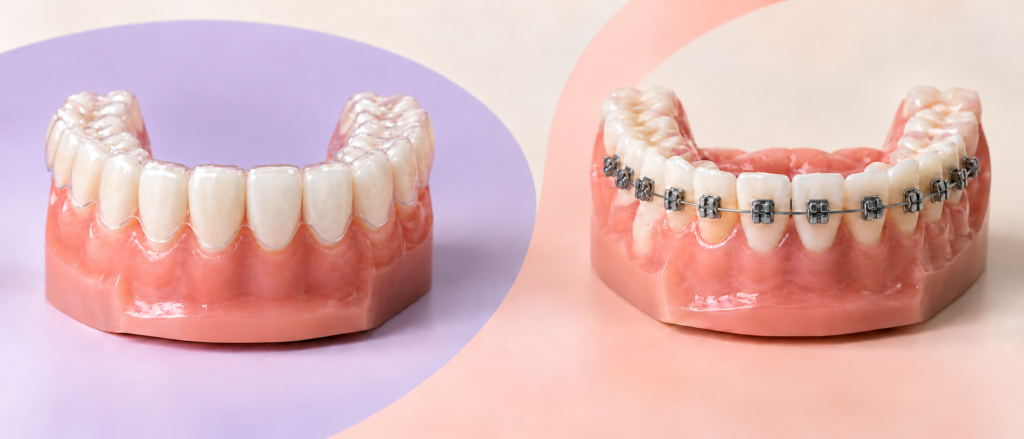
The Invisalign-versus-braces debate gets oversimplified all over the internet. In reality, the outcome has far less to do with which system you pick and far more to do with two things: whether your case is genuinely suited to clear aligners, and how closely your treatment is monitored along the way.
Invisalign has come a long way and can now treat a wide range of cases — from mild crowding to more complex bite corrections — but it isn’t the right fit for everyone. Severe rotations, certain bite discrepancies or cases requiring significant tooth movement sometimes still respond better to fixed braces, at least for part of the journey.
The bigger factor, though, is compliance and monitoring. Aligners only work if they’re worn 20–22 hours a day, and progress needs to be checked regularly to catch anything that isn’t tracking as planned. A well-monitored Invisalign case will consistently outperform a poorly-supervised one, regardless of how advanced the technology is.
If you’re weighing the two, the most useful question to ask isn’t “which is better” — it’s “which is better for my specific case, with the level of oversight I’ll actually get?” That’s exactly what we assess at your consult.